

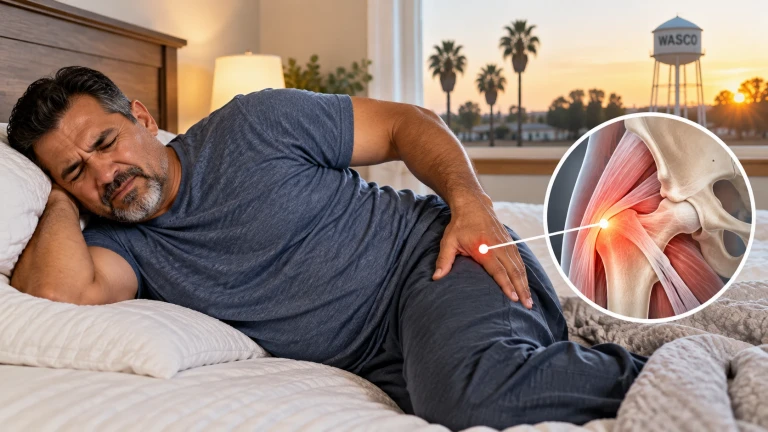
You finally get into bed after a long day, turn onto your favorite side, and feel an uncomfortable ache in your hip. You roll over, adjust your pillow, and try to settle in, but the pain keeps coming back.
Maybe your hip hurts only when you lie on it. Perhaps the pain wakes you up in the middle of the night or makes your first few steps in the morning uncomfortable.
If this happens regularly, you may wonder what's causing it and what you can do to sleep more comfortably.
Hip pain when sleeping is often caused by pressure on sensitive muscles, tendons, or cushioning tissues around the hip. Common reasons include hip bursitis, irritated tendons, arthritis, and pain coming from the lower back.
Where you feel the pain, when it gets worse, and what other symptoms you experience can help identify the possible cause.
Why Does My Hip Hurt When I Lie on My Side?
When you sleep on your side, your body places pressure on the outside of your hip.
Usually, this does not cause a problem. However, if the tissues around your hip are already irritated, that pressure can make them painful.
One common condition that causes this type of discomfort is called greater trochanteric pain syndrome, or GTPS.
Although the medical name sounds complicated, it simply describes pain involving the tissues around the bony area on the outside of your hip.
Patients often describe it as:
- Pain when sleeping on one side
- A sore spot on the outside of the hip
- Hip pain that gets worse at night
- Tenderness when pressing on the hip
- Pain when climbing stairs
- Aching after walking or standing
- Discomfort when getting up from a chair
Sometimes the pain travels down the outside of the thigh.
The good news is that many cases improve with appropriate exercise, changes to aggravating activities, and other conservative treatments.
What Causes Pain on the Outside of Your Hip?
Several conditions can cause discomfort around the hip.
1. Hip Bursitis
Hip bursitis is a familiar term for inflammation of a small fluid-filled sac called a bursa.
Bursae help reduce friction between bones, muscles, and tendons.
When a bursa on the outside of your hip becomes irritated, lying directly on that area can be uncomfortable.
You may notice tenderness when touching the side of your hip or pain when walking and climbing stairs.
However, not all outer hip pain is caused by bursitis.
2. Irritated Hip Tendons
Tendons connect muscles to bones.
The tendons on the outside of your hip help stabilize your pelvis when you walk, stand, or climb stairs.
If these tendons become painful or overloaded, you may experience discomfort during everyday activities.
This condition is sometimes called gluteal tendinopathy.
Patients generally describe it as a deep ache or soreness along the side of the hip.
It may become worse when sleeping on the affected side, standing on one leg, or walking uphill.
3. Hip Arthritis
Arthritis can also cause hip discomfort.
Unlike typical outer hip tendon pain, hip arthritis frequently produces pain in the groin or front of the hip.
Some people also experience stiffness, difficulty putting on shoes, or reduced hip movement.

Arthritis can occasionally cause pain felt in the buttock or thigh.
4. Lower Back Problems
Sometimes, what feels like hip pain actually comes from the lower back.
The nerves leaving your lower spine help control sensation and movement in your legs.
If one of these nerves becomes irritated, pain may travel into the buttock, hip, or leg.
This is why identifying the exact source of discomfort matters before beginning treatment.
Why Does My Hip Hurt When I Walk?
Walking places repeated demands on the muscles around your hips.
These muscles help keep your pelvis steady every time you take a step.
If the tendons or other tissues around the hip are sensitive, walking may trigger pain.
You might notice that your hip hurts more when:
- Walking long distances
- Climbing stairs
- Walking uphill
- Standing on one leg
- Carrying heavy groceries
- Getting up after sitting
Pain with these activities can occur with outer hip tendon problems, arthritis, and other musculoskeletal conditions.
A healthcare professional can evaluate which structures are most likely contributing.
Why Is One Hip More Painful Than the Other?
It is common to experience hip discomfort on only one side.
You may favor one leg while standing, regularly sleep on the same side, or have different strength and mobility between your hips.
A previous injury may also contribute.
For example, standing with most of your weight resting on one hip can increase pressure on certain tissues.
However, one-sided pain does not automatically mean your pelvis or spine is misaligned.
There are several possible causes, and the location of pain alone cannot establish the diagnosis.
How Can You Tell if Hip Pain Is Coming From Your Back?
Pain from your hip and pain from your lower back can sometimes feel similar.
Here are a few differences worth understanding.
Pain directly on the outside of your hip: This may suggest irritated hip tendons or bursitis, particularly when lying on that side is uncomfortable.
Pain deep in the groin: This may suggest a problem involving the hip joint itself.
Pain traveling from your back into your leg: This may indicate irritation of a nerve in the lower spine.
Pain with numbness, tingling, or muscle weakness: These symptoms raise concern for possible nerve involvement.
Because symptoms can overlap, a proper examination is more reliable than trying to diagnose the problem from one symptom.
Can Spinal Problems Contribute to Hip Pain?

Your spine, pelvis, and hips work together during many everyday movements.
For example, when you walk, your lower back and pelvis help coordinate movement while the hip muscles support your body.
Conditions affecting the lower spine can sometimes produce pain felt around the hip.
People with lower back discomfort may also change how they walk or stand, potentially increasing demands on surrounding muscles.
However, not all hip pain originates in the spine.
Pain located on the outside of the hip is often related to the hip's own tendons or other nearby tissues.
An accurate diagnosis should consider both possibilities without assuming a spinal cause.
Can Chiropractic Care Help With Hip Pain?
Chiropractic care may include assessment of certain musculoskeletal problems affecting movement, joints, and the spine.
At Campbell Chiropractic, Dr. Dennis Campbell specializes in Blair Upper Cervical Chiropractic, a focused approach involving the uppermost part of the spine.
The practice emphasizes individualized examination and consideration of spinal mechanics.
However, hip bursitis and irritated gluteal tendons are conditions involving structures around the hip.
There is currently insufficient evidence that upper cervical adjustments directly treat these conditions.
For people experiencing hip pain, an appropriate evaluation should determine whether symptoms come from the hip itself, the lower back, or another source.
Depending on the findings, hip-specific exercises, physical therapy, medical treatment, or referral to another healthcare professional may be more appropriate.
Upper cervical care should be considered only when a separate, clinically relevant spinal condition is identified.
How Can I Relieve Hip Pain at Night?
There are several practical steps you can try to improve comfort.
1. Avoid Sleeping Directly on the Painful Hip
If your right hip hurts, try sleeping on your back or left side.
Reducing direct pressure may help sensitive tissues settle.
2. Place a Pillow Between Your Knees
If you sleep on your side, place a pillow between your knees to keep your top leg comfortably supported.
This can help reduce pressure around the outside of the hip.
3. Try Sleeping on Your Back
Some people find back sleeping more comfortable, particularly with a pillow beneath the knees.
4. Avoid Crossing Your Legs for Long Periods
Crossing your legs can increase pressure around certain hip tendons.
If this position causes pain, try keeping both feet supported on the floor while sitting.
5. Strengthen the Muscles Around Your Hips
Appropriate strengthening can improve the hip muscles' ability to support walking, standing, and climbing stairs.
A physical therapist can recommend exercises based on your symptoms.
6. Modify Activities That Make Your Pain Worse
You do not necessarily need to stop walking or exercising.
However, temporarily reducing the distance, intensity, or frequency of painful activities may allow you to remain active without repeatedly aggravating symptoms.
Many people improve gradually with exercise and changes to activities that place excessive pressure on the painful tissues.

Should I Stretch a Painful Hip?
Stretching is not always the best solution for pain on the outside of your hip.
Some deep hip stretches can increase pressure on irritated tendons, particularly when the leg is pulled across the body.
If stretching consistently makes symptoms worse, stop that movement and seek guidance.
For certain outer hip tendon problems, gentle strengthening and avoiding painful compression may be more effective than aggressive stretching.
The most suitable exercises depend on the condition causing your pain.
When Should I See a Doctor for Hip Pain?
Mild hip discomfort may improve with appropriate self-care.
However, arrange a professional evaluation if:
- Hip pain repeatedly wakes you at night
- Walking or climbing stairs becomes difficult
- Pain continues for several weeks
- Symptoms are becoming progressively worse
- You develop persistent numbness or weakness
- Hip pain begins interfering with your normal activities
Seek urgent medical attention if you cannot bear weight after a fall, experience significant injury, or develop a hot, swollen hip accompanied by fever.
New severe weakness or symptoms involving loss of bladder or bowel control require emergency assessment.
Frequently Asked Questions About Hip Pain
Why does my hip hurt every night?
Nighttime hip pain may be caused by pressure on irritated tendons or bursae, arthritis, or another musculoskeletal condition. The location of pain and accompanying symptoms can help identify possible causes.
Why does my hip hurt when I sleep on my side?
Sleeping on your side puts pressure on the outside of your hip. If the tissues in that area are sensitive, this pressure can cause discomfort.
Can hip bursitis cause pain when walking?
Yes. Hip bursitis and other conditions affecting the outside of the hip can cause pain during walking, climbing stairs, and prolonged standing.
Why does my hip hurt when I get out of bed?
Morning hip pain may involve stiffness, arthritis, or irritated tissues around the hip. Symptoms that continue or worsen should be evaluated.
Can lower back problems cause hip pain?
Yes. Some lower back conditions can refer pain to the hip or buttock. Symptoms may also extend into the leg when a spinal nerve is affected.
Is walking good for hip pain?
Gentle walking may be helpful if it does not significantly aggravate symptoms. Some people benefit from temporarily reducing walking distances while following an appropriate strengthening program.
Can a chiropractor help determine why my hip hurts?
A qualified chiropractor may assess musculoskeletal symptoms and identify when additional hip evaluation or medical referral is appropriate. Upper cervical adjustments have not been established as a specific treatment for hip bursitis or gluteal tendon disorders.
What is the best sleeping position for hip pain?
Sleeping on your back or on the pain-free side with a pillow between your knees may reduce pressure on sensitive hip tissues.
Understanding Hip Pain in Wasco, CA
Hip pain should not routinely interfere with your sleep, walking, or everyday comfort.
Sometimes, simple changes to sleeping positions, exercise habits, and daily activities can reduce symptoms.
In other cases, recurring pain may indicate arthritis, irritated hip tendons, a lower back condition, or another problem requiring professional evaluation.
At Campbell Chiropractic, Dr. Dennis Campbell provides individualized Blair Upper Cervical Chiropractic evaluations for patients seeking an assessment of their spinal health.
The practice serves Wasco, Bakersfield, Shafter, Delano, and surrounding San Joaquin Valley communities.
If you are experiencing hip discomfort along with spinal symptoms, contact the practice to discuss whether an evaluation is appropriate and whether hip-specific medical care or rehabilitation may be needed.
Campbell Chiropractic
620 E St
Wasco, CA 93280
Phone: (661) 758-5131
Website: https://denniscampbelldc.com
Medical disclaimer: This article is for general educational purposes and does not replace an individual medical examination, diagnosis, or treatment plan. Chiropractic care is not appropriate for every cause of hip pain.


Leave a comment