

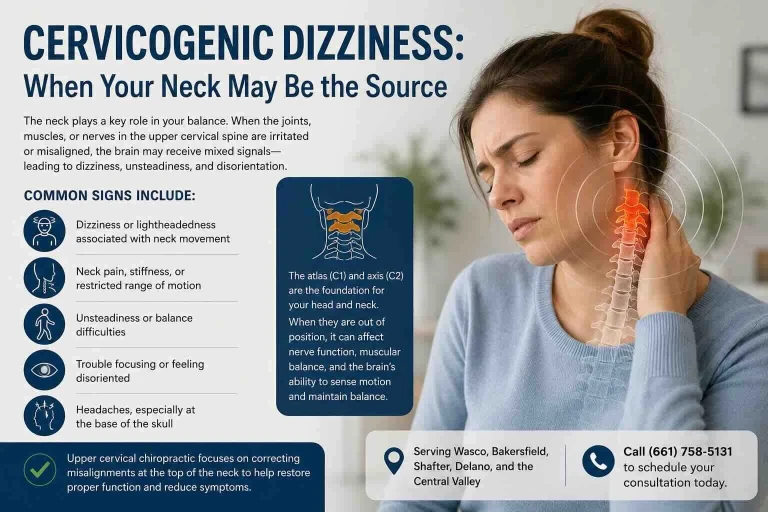
Cervicogenic Dizziness: When Your Balance Problem May Be Coming From Your Neck
You stand up and feel unsteady.
You turn your head while driving and suddenly feel disoriented. Walking through a grocery store makes you feel as though the floor is moving beneath you. Your tests may have ruled out an inner-ear disorder, yet the dizziness continues.
At the same time, your neck feels stiff, painful, or difficult to turn.
Most people assume that dizziness must come from the inner ear or brain. Those are important possibilities that must be evaluated. However, the neck also supplies the brain with information about the position and movement of the head.
When that information becomes inaccurate, the result may be cervicogenic dizziness.
For patients in Wasco, Bakersfield, Shafter, Delano, and surrounding Central Valley communities, evaluating the upper cervical spine may uncover a mechanical factor that has been overlooked.
What Is Cervicogenic Dizziness?
Direct answer: Cervicogenic dizziness is a feeling of imbalance, lightheadedness, disorientation, or unsteadiness associated with neck pain, stiffness, or restricted neck movement.
Unlike classic vertigo, it usually does not feel as though the room is rapidly spinning. Patients may instead describe:
- Feeling off-balance while walking
- Floating or swaying sensations
- Lightheadedness with neck movement
- Difficulty focusing visually
- Unsteadiness when turning the head
- Neck pain that worsens with dizziness
- Headaches originating near the base of the skull
Symptoms are often provoked by moving the neck or holding the head in one position for an extended period. Episodes may last minutes or hours, although some people experience a more persistent sense of imbalance.
How Can the Neck Affect Your Balance?
Your ability to remain balanced depends on three major sources of information:
Your inner ears detect head movement and acceleration.
Your eyes identify your position relative to the surrounding environment.
Sensors in your muscles and joints tell your brain where your body is positioned.
The third system is known as proprioception.
The upper neck contains a high concentration of proprioceptive receptors. These receptors continuously report the position of the head in relation to the body. Your brain compares that information with signals coming from your eyes and inner ears.

When all three systems agree, you feel stable.
When information from the neck conflicts with signals from the eyes and inner ears, the brain may have difficulty determining where the head is positioned. Researchers describe this as a sensory mismatch. It may contribute to disorientation, visual instability, unsteadiness, or dizziness associated with neck dysfunction.
What Causes Cervicogenic Dizziness?
Cervicogenic dizziness is frequently associated with an injury or condition affecting the cervical spine.
Possible contributing factors include:
- Whiplash from a motor vehicle accident
- A previous concussion or blow to the head
- Falls or sports injuries
- Chronic neck pain
- Restricted cervical movement
- Cervical arthritis or degeneration
- Prolonged forward-head posture
- Muscle tension around the base of the skull
- Repetitive occupational strain
Whiplash is especially relevant because the rapid movement of the head can injure cervical joints, muscles, ligaments, and sensory receptors. Dizziness following trauma can also have multiple causes, so post-traumatic BPPV, concussion-related problems, and other vestibular conditions must be considered.
In the Central Valley, long hours driving, working on agricultural equipment, performing physical labor, or looking downward at machinery can place persistent stress on the neck. These activities do not automatically cause cervicogenic dizziness, but they may aggravate an existing cervical problem.
Why Is Cervicogenic Dizziness Difficult to Diagnose?
There is no single laboratory test, scan, or examination that conclusively proves someone has cervicogenic dizziness.
It is considered a diagnosis of exclusion. This means healthcare providers must first investigate other possible causes, including:
- Benign paroxysmal positional vertigo
- Vestibular migraine
- Ménière’s disease
- Vestibular neuritis
- Medication side effects
- Blood pressure problems
- Heart rhythm abnormalities
- Neurological disorders
- Stroke or transient ischemic attack
A diagnosis becomes more likely when dizziness and neck symptoms follow the same pattern. For example, the neck pain may begin before the dizziness, both symptoms may worsen together, and specific neck positions may reproduce the unsteadiness.
A thorough evaluation may include neurological testing, vestibular testing, balance assessment, cervical range-of-motion testing, imaging, and examination of head-position awareness.
Can Upper Cervical Chiropractic Help Cervicogenic Dizziness?
Direct answer: Upper cervical chiropractic may help selected patients when neck dysfunction is contributing to dizziness, but it is not appropriate for every cause of dizziness.
Research reviews have found evidence that cervical manual therapy can reduce dizziness, neck pain, and balance-related disability in some patients with suspected cervicogenic dizziness. Treatment studies have included cervical mobilization, manipulation, soft-tissue care, exercises, and sensorimotor rehabilitation. The evidence is encouraging but not conclusive, and additional high-quality research is still needed.
Related article

Chiropractic Care for Headaches and Migraines: How to Treat Them Effectively
Jul 12, 2022Upper cervical chiropractic does not treat an inner-ear infection, stroke, heart condition, or every neurological cause of dizziness.
Its role is to evaluate and address dysfunction involving the upper cervical spine when the patient’s history and examination suggest that the neck may be contributing to the problem.
Why Focus on the Atlas and Axis?
The atlas and axis are the first two vertebrae beneath the skull.
They provide a large portion of the neck’s rotation while supporting the weight of the head. The deep joints and muscles surrounding this area contain sensory receptors that contribute to head-position awareness and postural control.
If the upper neck becomes restricted or mechanically imbalanced, the signals coming from those receptors may become less reliable. Neck pain can further alter proprioceptive input and the way the brain coordinates vision, balance, and movement.
The objective of upper cervical care is not to adjust every area of the spine. It is to determine whether a measurable problem at the top of the neck is present and whether correcting that problem changes the patient’s function.
What Does a Blair Upper Cervical Evaluation Include?
At Campbell Chiropractic, the evaluation begins with a detailed history.
Important questions include:
- Did the dizziness begin after an accident or fall?
- Does neck movement reproduce the symptoms?
- Did neck pain begin before the dizziness?
- Are there headaches near the base of the skull?
- Have inner-ear and neurological causes been evaluated?
- Which treatments have already been attempted?
The Blair Upper Cervical technique uses detailed imaging to study the relationship between the skull, atlas, and axis. When a correction is indicated, it is calculated according to the patient’s individual anatomy.
The correction uses minimal force and does not require forceful twisting, popping, or cracking of the neck. Follow-up examinations help determine whether the correction is holding and whether neck movement, posture, or balance is changing.
What Improvements Might a Patient Notice?
Results vary according to the underlying cause and the length of time the problem has been present.
When cervical dysfunction is a meaningful contributor, patients may notice:

- Less neck pain or stiffness
- Improved ability to turn the head
- Fewer episodes of unsteadiness
- Greater confidence while walking
- Improved tolerance for driving
- Reduced headache frequency
- Less visual disorientation with movement
- Better balance during daily activities
Some patients may also need vestibular rehabilitation, neck exercises, postural training, or medical treatment. Addressing both cervical dysfunction and balance-system adaptation may be more appropriate than relying on one treatment alone.
When Is Dizziness an Emergency?
New dizziness should not automatically be assumed to originate in the neck.
Seek emergency medical attention when dizziness is sudden, severe, persistent, or accompanied by:
- Facial drooping
- Arm or leg weakness
- Numbness
- Slurred speech
- Double vision
- Severe difficulty walking
- Loss of coordination
- Fainting
- Chest pain
- A sudden, severe headache
- Continuous vomiting
A stroke affecting the brainstem or cerebellum can closely resemble an inner-ear balance disorder. New, severe dizziness lasting hours or days—especially with vomiting or difficulty walking—requires immediate medical assessment.
Looking Beyond the Inner Ear
Dizziness is a symptom, not a complete diagnosis.
When inner-ear testing is normal, medications have not solved the problem, and dizziness consistently appears alongside neck pain or restricted movement, the cervical spine deserves attention.
That does not mean every unexplained dizzy spell originates in the neck. It means the neck should not be ignored when the symptom pattern points in that direction.
Campbell Chiropractic provides Blair Upper Cervical evaluations for patients in Wasco, Bakersfield, Shafter, Delano, and throughout Kern County and the San Joaquin Valley.
The office is located at 620 E Street, Wasco, CA 93280. Call (661) 758-5131 to schedule a consultation.
Frequently Asked Questions
1. Is cervicogenic dizziness the same as vertigo?
No. Vertigo typically produces a spinning or rotational sensation. Cervicogenic dizziness more commonly causes imbalance, lightheadedness, swaying, or disorientation associated with neck symptoms.
2. How do I know whether my dizziness is coming from my neck?
The possibility is stronger when neck pain begins before the dizziness, both symptoms worsen together, and neck positions reproduce the problem. Other vestibular, neurological, cardiovascular, and medication-related causes must be ruled out.
3. Can an old whiplash injury cause dizziness?
A previous whiplash injury may contribute to dizziness by affecting cervical movement, pain, muscle control, or proprioceptive signaling. Dizziness following trauma can be multifactorial and requires proper evaluation.
4. Does Blair upper cervical care involve neck twisting?
No. Blair corrections are designed around individualized imaging and use a precise, low-force contact without forceful rotation or neck cracking.
5. Can upper cervical chiropractic cure all dizziness?
No. Dizziness has many possible causes. Upper cervical care is most relevant when examination findings indicate that cervical dysfunction may be contributing to the symptoms.


Leave a comment