

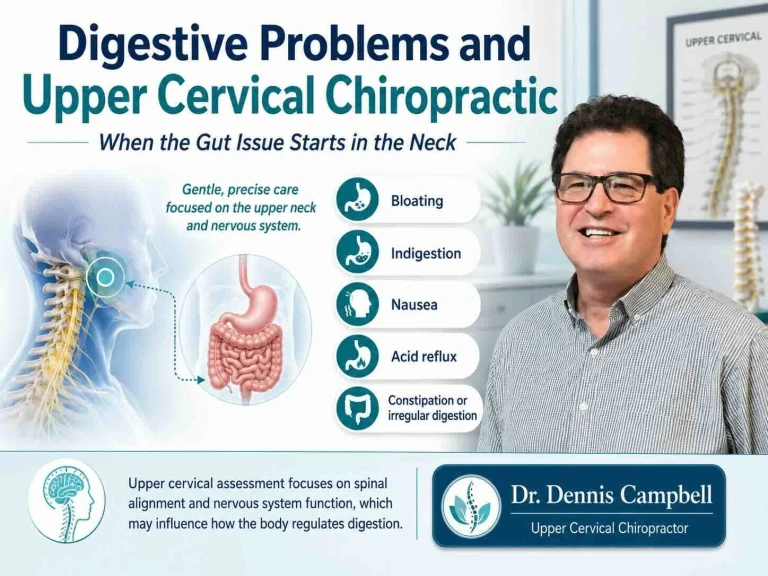
You have changed your diet. Eliminated gluten, dairy, caffeine, alcohol. You have tried probiotics, enzymes, fiber supplements, and prescription antacids. You have had the endoscopy.
Maybe the colonoscopy too. And the answer is usually the same: everything looks normal, try managing your stress. Meanwhile your stomach still bloats after meals, your bowels are unpredictable, and you are quietly organizing your life around a gut that will not cooperate.
For a lot of people in Wasco, Bakersfield, and across the San Joaquin Valley, the missing piece is not in the gut at all. It is at the top of the neck.
The Vagus Nerve and Why Your Stomach Answers to Your Brainstem
The vagus nerve is the longest cranial nerve in the body. It starts in the brainstem and runs down through the neck, chest, and abdomen, branching into nearly every major organ along the way. It carries approximately 75% of all parasympathetic signals in the body, meaning it is the primary nerve responsible for the "rest and digest" functions that keep the gastrointestinal system working.
When the vagus nerve is functioning properly, it stimulates gastric acid production, controls the rhythmic contractions (peristalsis) that move food through the digestive tract, regulates sphincter tone at the esophageal and pyloric junctions, promotes bile release from the gallbladder, and modulates the inflammatory response in the gut lining.
When it is not functioning properly, you get some combination of acid reflux, bloating, gastroparesis (delayed stomach emptying), constipation, diarrhea, cramping, and that general sense that your digestive system has lost its timing.
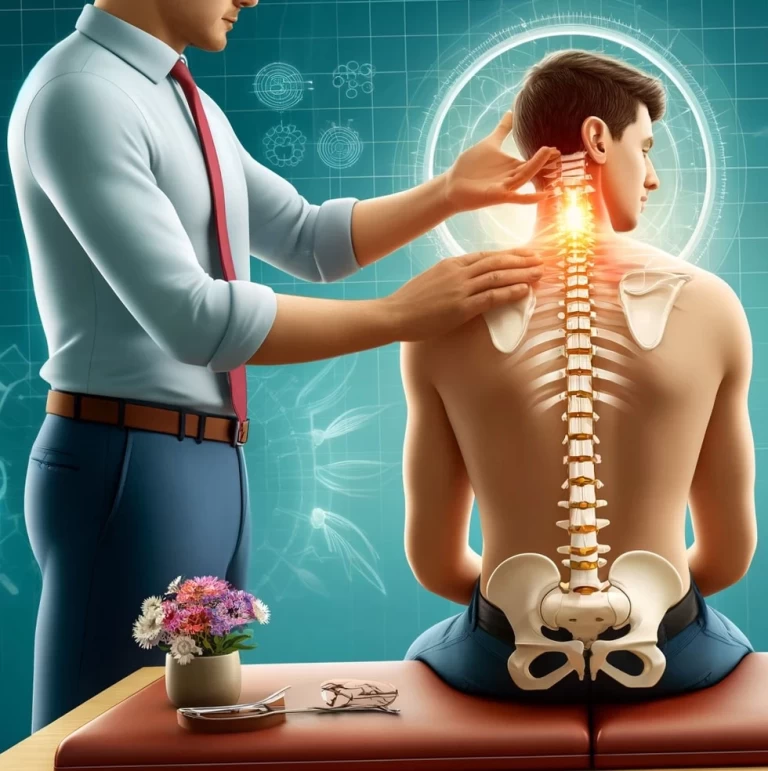
The vagus nerve exits the skull through the jugular foramen, immediately adjacent to the atlas vertebra (C1). Its motor nuclei, the dorsal motor nucleus and nucleus ambiguus, are located in the medulla oblongata of the brainstem, which sits directly above the atlas. This anatomical proximity is the reason an atlas misalignment can disrupt digestive function without any structural problem existing in the gut itself.
How Atlas Misalignment Disrupts Digestion
When the atlas shifts out of its normal position, it can create mechanical irritation at the brainstem, where the vagal nuclei are located. This does not sever the nerve or block it completely. It reduces the quality and efficiency of the parasympathetic signals traveling to the digestive organs. The gut does not shut down. It just stops working the way it should.
Gastric motility slows. Food sits in the stomach longer than it should, producing bloating and nausea. The lower esophageal sphincter loses tone, allowing acid to creep upward into the esophagus. The intestines lose their coordinated rhythm, alternating between too fast and too slow, which is exactly the pattern seen in irritable bowel syndrome.
Gastroenterologists are trained to look at the gut. They scope it, image it, test its chemistry, and biopsy its lining. When those tests come back normal, the diagnosis often becomes IBS, which is essentially a label that says the gut is malfunctioning but we cannot find a structural reason why. The structural reason may not be in the gut. It may be in the brainstem's ability to regulate the gut.
IBS, GERD, and the Overlooked Nerve

Irritable bowel syndrome affects an estimated 25 to 45 million people in the United States. Gastroesophageal reflux disease affects roughly 20% of the adult population. Both conditions are managed, often lifelong, with medications that suppress symptoms without addressing the underlying neurological dysfunction.
Proton pump inhibitors reduce acid production. Anti-spasmodics calm intestinal contractions. Laxatives and anti-diarrheals push the bowels in one direction or the other. These drugs can provide relief, and for some people they are necessary.
But they are managing a downstream effect. The signal telling the gut how to behave originates in the brainstem, travels through the vagus nerve, and can be disrupted by a structural problem at the craniocervical junction.
This does not mean every case of IBS or GERD is caused by an atlas misalignment. But it means the upper cervical spine deserves evaluation, especially when dietary and pharmaceutical approaches have provided incomplete relief.
Blair Upper Cervical Care for Digestive Issues in Wasco
At Campbell Chiropractic, Dr. Dennis Campbell uses the Blair Upper Cervical technique, a highly specific method of analyzing and correcting atlas and axis misalignment. As one of only a few hundred Blair practitioners worldwide, Dr. Campbell brings a level of precision to the evaluation process that most chiropractic offices do not offer.
The evaluation begins with a thorough health history that includes questions about digestive symptoms, injury history, and prior treatments. Precision imaging of the upper cervical spine reveals whether the atlas has shifted, and if so, the exact direction and degree of displacement. The correction is engineered from this data. It is specific to the patient's anatomy, uses minimal force, and involves no twisting, popping, or cracking of the neck.
As Dr. Campbell often says, all symptoms are effects, which must have a cause. The objective is to find and correct that cause. When the atlas is restored to proper alignment, the brainstem and vagus nerve can function without interference. Digestive function often improves as a result, not because the gut was treated, but because the system controlling the gut was freed to do its job.

What Patients Notice
Many patients report digestive improvements within the first few weeks of care. Bloating decreases. Bowel regularity improves. Acid reflux episodes become less frequent or less severe. Some patients notice changes they were not expecting: better appetite regulation, reduced abdominal cramping, or less post-meal fatigue.
These changes tend to accompany improvements in other areas as well, such as sleep, neck mobility, and overall energy. This makes sense when you understand that the vagus nerve does not just regulate digestion. It influences heart rate, inflammatory response, and mood. Correcting the interference at the brainstem benefits the entire parasympathetic system.
Who Should Consider Evaluation
If you are in Wasco, Shafter, Delano, Bakersfield, Visalia, Fresno, or anywhere across the San Joaquin Valley and you have been living with digestive problems that medication and diet have not fully resolved, the upper cervical spine may hold the answer.
This is especially worth pursuing if your symptoms began after a neck or head injury, if you also experience neck stiffness or headaches, or if you have been given a diagnosis of IBS or functional dyspepsia with no clear cause.
Campbell Chiropractic is at 620 E St, Wasco, CA 93280. Call (661) 758-5131 for a free consultation.


Leave a comment