

The pain is everywhere. Your shoulders, your hips, your ribs, your thighs. It moves. It stays. It changes intensity for no reason you can identify. Your doctor ran labs. Everything came back normal.
You were handed a diagnosis of fibromyalgia and a prescription, and somewhere in the back of your mind a question formed that nobody answered: if the tests are normal, where is this pain actually coming from?
Dr. Dennis Campbell has a framework for exactly this kind of question. All symptoms are effects, which must have a cause. Fibromyalgia is not the cause. It is the name given to a set of effects. The cause may be sitting at the top of your spine.
Fibromyalgia Is a Volume Problem
Fibromyalgia affects roughly 4 million adults in the United States. It is characterized by widespread musculoskeletal pain lasting at least three months, chronic fatigue, unrefreshing sleep, and cognitive dysfunction often called fibro fog. Women are diagnosed at significantly higher rates than men, and the condition most commonly appears between ages 30 and 50.
The current understanding of fibromyalgia centers on a concept called central sensitization. The central nervous system, specifically the brain and spinal cord, becomes hypersensitive to incoming sensory signals.
Pain processing circuitry amplifies input that should register as mild or neutral, turning ordinary stimuli into something the body interprets as painful. Light pressure hurts. Normal temperature changes hurt. Physical activity that should produce manageable soreness instead produces days of debilitating pain.
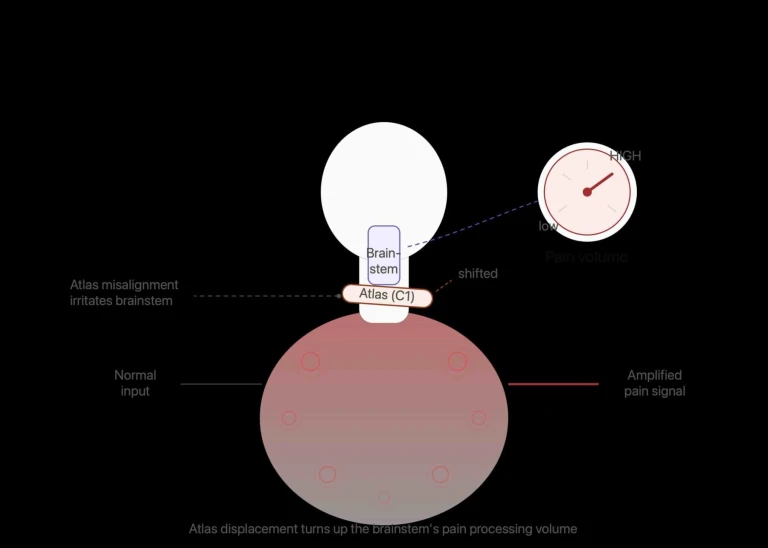
Think of it as a volume knob. In a healthy nervous system, the volume is set at a reasonable level. A tap on the shoulder registers as a tap. In fibromyalgia, the volume has been turned up so high that the same tap registers as a blow. The input has not changed. The processing has.
The question is what turned the volume up.

The Brainstem and the Wind-Up Phenomenon
The brainstem is the body's central processing station for pain modulation. It receives sensory input from the entire body and decides how much of that input reaches conscious awareness as pain. It is the structure responsible for setting the gain on the pain system, and it sits directly above the atlas vertebra at the craniocervical junction.
When the atlas is displaced, it creates low-grade mechanical irritation to the lower brainstem, specifically the medulla oblongata and the upper segments of the spinal cord. This does not produce a sudden, sharp injury. It produces a sustained, low-level interference with the pain processing circuits that gradually shifts the nervous system into a state of heightened reactivity.
One specific mechanism involved in this shift is called the wind-up phenomenon, also known as temporal summation. In a normal nervous system, repeated mild stimuli produce a consistent, proportional response. In a sensitized nervous system, repeated mild stimuli produce an escalating response.
Each signal arrives a little louder than the last. Over time, the nervous system reaches a point where it is amplifying everything, including signals from muscles, joints, skin, and organs that are not actually injured or inflamed.
Wind-up is not a psychological phenomenon. It is a measurable change in how dorsal horn neurons in the spinal cord and brainstem nuclei process incoming signals. And if the brainstem is under structural irritation from an atlas displacement, the conditions for wind-up are sustained indefinitely.
Why the Injury That Started It Was Forgotten
Ask someone with fibromyalgia when the pain began, and you will often hear a specific trigger: a car accident, a fall, a surgery, a difficult pregnancy, a prolonged period of emotional stress combined with physical strain. These events share one characteristic. They can all displace the atlas.
The atlas has no interlocking facet joints. It is held in position by muscles and ligaments alone, making it the most structurally vulnerable vertebra in the spine. A sudden force to the head or neck can shift it out of position, and because the displacement may produce no immediate neck pain, it goes undetected.

The gap between the triggering event and the full onset of fibromyalgia symptoms is what makes the connection invisible. A rear-end collision at 28 may not produce widespread pain until 35. By then, nobody thinks to connect the two. The atlas stays displaced. The brainstem stays irritated. The volume stays up. And the diagnosis arrives without anyone asking what happened to the neck seven years ago.
At Campbell Chiropractic, Dr. Campbell asks. The intake process includes a detailed history that goes back years, sometimes decades, specifically looking for the injury that set the compensation pattern in motion.
What Conventional Treatment Addresses and What It Misses
The most commonly prescribed medications for fibromyalgia are pregabalin (Lyrica), duloxetine (Cymbalta), and milnacipran (Savella). Each works by altering neurotransmitter activity in the brain and spinal cord to reduce pain signaling. Exercise, sleep hygiene, and cognitive behavioral therapy are recommended alongside medication. These approaches can help. Some patients experience meaningful symptom reduction.
What they do not do is address the structural irritation at the brainstem that may be sustaining the central sensitization. If the atlas is displaced and the brainstem's pain modulation circuits are being mechanically compromised, medication is trying to turn the volume down while something physical is holding the knob up. It can take the edge off. It cannot fully override the structural input.
Blair Upper Cervical Care for Fibromyalgia in Wasco
Dr. Dennis Campbell is one of only a few hundred Blair Upper Cervical practitioners in the world. The Blair technique uses precision imaging to identify the exact direction and degree of atlas and axis misalignment specific to each patient's anatomy. No two corrections are the same because no two people's joint geometry is the same.
The adjustment involves no twisting, no cracking, and no forceful manipulation. The force is minimal, controlled, and precisely directed. For fibromyalgia patients whose nervous systems are already amplifying every input, this gentleness is not a luxury. It is a clinical necessity. The last thing a sensitized system needs is a broad, generalized force applied to the spine.
f the atlas is holding its corrected position, no adjustment is made. The goal is stability, not repeated intervention. When the atlas stays in place, the mechanical irritation at the brainstem resolves, and the pain processing circuits have an opportunity to recalibrate. The volume starts to come down.

What Patients Notice
Sleep is usually the first thing to change. Many fibromyalgia patients report sleeping more deeply and waking less exhausted within the first few weeks. This makes sense: the brainstem directly governs sleep architecture, and reducing irritation at that level improves sleep quality before it improves pain.
Pain reduction follows. Not all at once. Some areas quiet down before others. The widespread burning becomes more localized, then less intense, then less constant. Brain fog lifts. Energy returns in increments.
Some patients find that their medications become more effective once the brainstem is no longer working against them. Others, under the guidance of their prescribing physician, are able to reduce dosage over time.
The improvement is not instantaneous. Fibromyalgia developed through a slow process and it resolves through a slow process. But the trajectory matters. Each week slightly better than the last is a fundamentally different experience than each year slightly worse.
Finding Help in the San Joaquin Valley
If you are in Wasco, Bakersfield, Shafter, Delano, Visalia, Fresno, or anywhere across the San Joaquin Valley and fibromyalgia has been your reality for months or years without adequate relief, the atlas vertebra is worth evaluating.
You do not need to stop your current treatment to explore this. Upper cervical care complements medical management by addressing a structural variable that medication cannot reach.
Campbell Chiropractic is at 620 E St, Wasco, CA 93280. Call (661) 758-5131 for a free consultation with Dr. Dennis Campbell.
Medical note: Tinnitus can have auditory, neurological, medication-related, vascular, musculoskeletal, and other causes. Upper cervical chiropractic should not replace appropriate evaluation by a physician, ENT specialist, or audiologist when indicated.


Leave a comment