

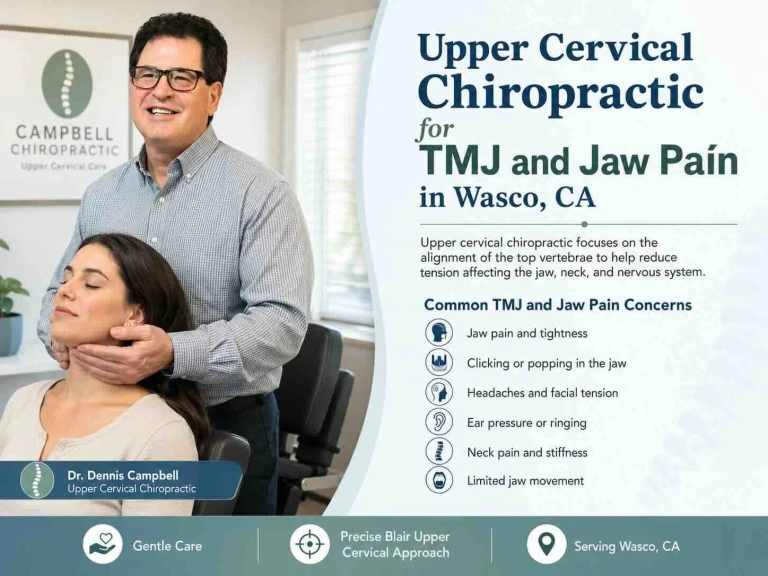
Jaw pain is one of those conditions that quietly takes over your life. It changes how you eat, how you sleep, how you talk, and how you feel by the end of a long day. For some people it shows up as a clicking or popping sound when they open their mouth.
For others it is a dull ache that radiates into the ear, the temple, or down into the neck. Some wake up with a locked jaw or teeth that ache from grinding through the night.
Temporomandibular joint disorder — TMJ or TMD — affects millions of Americans and remains one of the most undertreated and misunderstood pain conditions in primary care.
Most patients cycle through dental splints, anti-inflammatory medications, and physical therapy without finding lasting relief. What they rarely hear about is the structural connection between the jaw and the upper cervical spine — and why correcting one often resolves the other.
Dr. Dennis Campbell at the Wasco chiropractic office on East Street has seen that connection play out clinically, and the anatomy behind it is more straightforward than most people realize.
What Is the Temporomandibular Joint and Why Does It Dysfunction
The temporomandibular joint is the hinge connecting the lower jaw to the temporal bone of the skull, just in front of each ear. It is one of the most complex joints in the human body — capable of hinging, sliding, and rotating simultaneously — and it is in near-constant use every time you speak, chew, swallow, or yawn.
TMJ dysfunction occurs when this joint is placed under uneven stress, when the surrounding muscles are chronically overloaded, or when the disc cushioning the joint slips out of position. The result is pain, restricted movement, clicking or popping, headaches at the temples, earaches, and in some cases, a jaw that locks open or closed.
What standard dental and medical evaluations frequently miss is that the jaw does not function in isolation.
It is biomechanically linked to the upper cervical spine through shared musculature, neurological pathways, and the structural balance of the skull. When that balance is disrupted by atlas misalignment, the jaw pays a price.
The Atlas-Jaw Connection: Why the Neck and Jaw Are Not Separate Problems
Related article
Understanding Tinnitus and Exploring Upper Cervical Chiropractic as a Potential Treatment
Aug 18, 2023The atlas vertebra sits directly beneath the skull. The muscles that attach to the base of the skull and the temporal bone — the same bone the jaw hinges from — are directly influenced by the position of the atlas. When the atlas shifts out of its optimal alignment, even slightly, it creates asymmetric tension in the suboccipital and pterygoid muscle groups that control jaw movement and position.
That muscular asymmetry changes how the jaw tracks when it opens and closes. Instead of moving smoothly along a balanced arc, it deviates. The disc inside the joint is subjected to uneven loading. Over time, that uneven loading produces the clicking, the pain, and the progressive dysfunction that TMJ patients know well.
The neurological connection runs equally deep. The trigeminal nerve — the primary sensory nerve for the face and jaw — has its nucleus in the brainstem, directly adjacent to where the atlas sits. Atlas displacement that places mechanical stress on the brainstem can sensitize the trigeminal system, amplifying jaw pain signals beyond what the local joint pathology alone would produce.
This is why TMJ patients so frequently report that their jaw pain is accompanied by headaches, neck tension, and ear symptoms. Those are not separate conditions. They share a common structural origin.
Who Develops TMJ Disorder and What Triggers It
TMJ dysfunction rarely appears without a contributing cause, though patients often struggle to identify one because the onset can be gradual. Common contributing factors include:
- Whiplash or head trauma that displaces the atlas and alters the structural balance of the skull and jaw simultaneously
- Chronic postural stress from extended screen use, driving, or physical labor that loads the cervical spine asymmetrically over time
- Dental procedures requiring prolonged mouth opening that overstress the joint capsule
- Bruxism — teeth grinding, often during sleep — which places compressive load on the joint and is frequently worsened by atlas-related muscular tension
- Orthodontic changes that alter bite mechanics without addressing the underlying cervical structural picture
In Wasco and the Central Valley, where agricultural and physical labor are daily realities, postural and trauma-related contributors to TMJ are common. Long hours on equipment, repetitive physical demands, and vehicle accidents on rural roads all create the conditions for atlas displacement and the jaw dysfunction that often follows.
Why Standard TMJ Treatments Produce Incomplete Results
- The conventional treatment path for TMJ typically involves:
- Dental night guards to protect teeth from grinding and reduce joint compression during sleep
- Anti-inflammatory medications or muscle relaxants for acute pain management
- Physical therapy targeting the jaw musculature directly
- In more severe cases, corticosteroid injections or surgical intervention
Related article

Understanding Cervicogenic Headache: Relief Through Upper Cervical Chiropractic Care
Mar 15, 2024Each of these approaches addresses the jaw in isolation. Night guards reduce the impact of bruxism but do not correct the muscular asymmetry driving it. Physical therapy strengthens and stretches the jaw muscles but cannot resolve the atlas displacement creating the asymmetric tension those muscles are responding to.
The result is management rather than resolution — symptom control that requires ongoing intervention because the structural root cause remains untouched.
Patients who have been wearing a night guard for years and still wake up with jaw pain are living that gap. The guard is doing its job. The underlying problem is still there.
What Dr. Dennis Campbell's Evaluation Process Looks Like
The first appointment begins with a thorough health history. For TMJ patients specifically, Dr. Campbell looks at the full timeline — when the jaw symptoms began, whether there was a preceding injury or dental procedure, what the headache and neck pain pattern looks like, and what treatments have been tried. That history frequently reveals the structural event that started the pattern.
Precision upper cervical imaging follows. Cone beam computed tomography or detailed X-ray analysis maps the exact position of the atlas relative to the skull and axis — measuring rotation, lateral displacement, and angular deviation with a level of precision that standard imaging does not provide.
For TMJ patients, this imaging often reveals an atlas misalignment that has been present and undetected throughout the entire course of dental and medical treatment.
Objective neurological testing provides additional data before any correction is considered:
- Paraspinal infrared thermography identifies asymmetric neurological activity along the cervical spine, indicating areas of nervous system stress
- Leg length and postural analysis documents the compensatory pattern the entire spine has built around the atlas displacement
- Findings are reviewed in totality before any adjustment decision is made
The correction itself is precise and gentle. No twisting of the neck, no audible pop, no aggressive manipulation. The force is low, the contact is specific to the upper cervical segment, and the vector is calculated from the imaging data.
For patients already dealing with facial pain and muscular hypertonicity, the non-aggressive nature of upper cervical correction is clinically appropriate and generally well tolerated.
Related article

Are You Suffering From Fibromyalgia? Upper Cervical Chiropractic May Be the Answer
Dec 02, 2022What TMJ Patients Typically Experience After Upper Cervical Correction
Results vary by patient and by how long the atlas misalignment has been present. Some patients notice jaw tension easing within the first day or two following correction — a softening of the chronic muscular tightness that has been gripping the base of the skull and jaw.
Others experience more gradual improvement as the atlas stabilizes in its corrected position and the surrounding musculature begins to release its compensatory patterns.
What most TMJ patients who respond to upper cervical care describe is a qualitative shift — not just reduced pain, but a change in how the jaw feels during normal use. Less effort to open and close.
Less clicking. Morning stiffness that progressively diminishes. Sleep that improves as nighttime bruxism decreases alongside the reduction in cervical muscular tension.
Upper cervical care is not a replacement for dental management where genuine joint pathology exists. But for patients whose TMJ symptoms are driven or amplified by atlas misalignment, it addresses the structural root that dental treatment alone cannot reach.
Jaw Pain Is Not Something You Just Learn to Live With
A lot of TMJ patients in Wasco have been managing their symptoms for so long that they have stopped expecting resolution. They have accepted the clicking, the morning aches, the tension headaches as permanent features of daily life.
That acceptance is understandable. It is also worth questioning when a structural contributor has never been properly evaluated.
The jaw and the upper cervical spine are not separate systems. Treating one without evaluating the other leaves the most important part of the structural picture unaddressed.
Dr. Dennis Campbell's chiropractic office is located at 620 E Street, Wasco, CA 93280.
Call (661) 758-5131 to schedule a consultation.
If jaw pain has been a long-term problem and standard treatments have not provided lasting relief, a precision upper cervical evaluation is a logical and non-invasive next step.


Leave a comment