


Vertigo is a false sensation of spinning or movement, while dizziness refers to feeling lightheaded, unsteady, or off-balance. Causes range from benign inner ear issues to serious conditions requiring emergency care. About 20-30% of people experience vertigo or dizziness during their lifetime. Many cases—especially cervicogenic dizziness, respond well to upper cervical chiropractic care, which addresses neck-related causes that conventional treatments often miss.
What You'll Learn
- The difference between vertigo and other types of dizziness
- Common causes—from inner ear problems to neck issues
- Warning signs that require emergency care
- How the neck contributes to balance problems
- Treatment options including upper cervical chiropractic
- Self-assessment to determine if you need professional care
Medical Disclaimer: This content is for informational purposes only and does not constitute medical advice. Vertigo and dizziness can indicate serious conditions. Always consult with a qualified healthcare provider for diagnosis and treatment.
Vertigo vs. Dizziness: What's the Difference?
People often use "vertigo" and "dizziness" interchangeably, but they describe different sensations. Understanding the distinction helps you communicate with healthcare providers and guides appropriate treatment.
Vertigo
Vertigo is a specific type of dizziness where you feel like you or your surroundings are spinning, tilting, or moving, even when you're completely still. It's often described as:
- A spinning sensation (like being on a merry-go-round)
- Feeling like the room is rotating around you
- A sensation of being pulled to one side
- Tilting or swaying feelings
Vertigo typically results from problems with the vestibular system—the inner ear and brain structures that control balance.
Other Types of Dizziness
- Lightheadedness: Feeling faint or like you might pass out. Often related to blood pressure changes, dehydration, or standing up too quickly.
- Disequilibrium: Feeling unsteady or off-balance, especially while walking. You don't feel spinning, but struggle to maintain stability.
- Presyncope: The feeling that you're about to faint, often with visual changes, sweating, or nausea.
What Causes Vertigo and Dizziness?
Causes are broadly categorized as peripheral (inner ear-related) or central (brain-related). A third category, cervicogenic dizziness, originates from the neck and is often overlooked.
Peripheral Causes (Inner Ear)
Benign Paroxysmal Positional Vertigo (BPPV): The most common cause of vertigo. Small calcium crystals in the inner ear become dislodged and move into the semicircular canals, triggering brief but intense spinning sensations with head movements. Episodes typically last less than a minute but recur with position changes.
Vestibular Neuritis: Viral infection of the vestibular nerve causes sudden, severe vertigo lasting several days to weeks. Usually occurs without hearing loss.
Labyrinthitis: Similar to vestibular neuritis but also involves hearing loss and tinnitus (ringing in the ears). Usually follows a viral infection.
Meniere's Disease: A chronic condition causing episodes of vertigo, hearing loss, tinnitus, and a feeling of fullness in the ear. Episodes can last hours and recur over years.
Central Causes (Brain-Related)
Less common but potentially more serious:
- Vestibular Migraine: Migraine episodes that include vertigo, with or without headache
- Stroke or TIA: Reduced blood flow to the brain—particularly the cerebellum or brainstem
- Multiple Sclerosis: Demyelinating condition that can affect balance centers
- Brain Tumors: Acoustic neuroma and other tumors affecting the vestibular system
Cervicogenic Dizziness (Neck-Related)
This is where the neck connection becomes crucial. Cervicogenic dizziness occurs when problems in the cervical spine, particularly the upper neck, send faulty signals to the brain's balance centers.
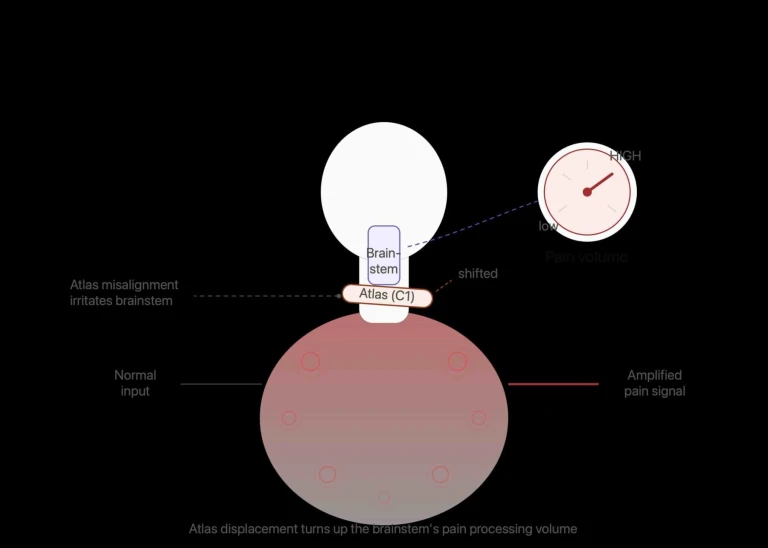
Your neck contains rich sensory receptors (proprioceptors) that constantly tell your brain about head position. When the upper cervical vertebrae are misaligned, these receptors send conflicting information, creating a "sensory mismatch" that the brain interprets as dizziness or vertigo.
Common causes of cervicogenic dizziness include:
- Whiplash injuries from car accidents
- Falls or head injuries (even years prior)
- Poor posture and forward head position
- Arthritis or degenerative changes in the cervical spine
Upper cervical subluxation (C1-C2 misalignment)
The first modern description of cervical vertigo dates to 1945. Despite this long history, cervicogenic dizziness remains underdiagnosed because standard tests don't specifically evaluate neck-related causes. Many patients make repeated visits to multiple specialists—ENTs, neurologists, cardiologists—before the cervical connection is identified.
CALL 911 OR GO TO THE ER IMMEDIATELY IF VERTIGO/DIZZINESS OCCURS WITH:
- Sudden severe headache ("thunderclap headache")
- Difficulty speaking or understanding speech
- Vision changes or double vision
- Weakness or numbness in face, arm, or leg
- Difficulty walking or severe loss of coordination
- Chest pain or heart palpitations
- High fever (over 101°F/38.3°C)
- Loss of consciousness
These symptoms may indicate stroke, brain hemorrhage, or other life-threatening conditions. Time is critical.
How Is the Cause Determined?
Diagnosing vertigo and dizziness can be challenging because there's no single test that identifies the cause. Diagnosis typically involves:
Medical History and Physical Exam
Your healthcare provider will ask detailed questions about your symptoms:
- Does the room spin, or do you feel faint?
- How long do episodes last?
- What triggers the dizziness?
- Do you have hearing changes or tinnitus?
- Any history of head or neck trauma?
- Do you have neck pain or stiffness?
Specialized Tests
- Dix-Hallpike Test: Evaluates for BPPV by moving your head into specific positions and observing eye movements (nystagmus).
- Head Impulse Test: Checks the vestibulo-ocular reflex by quickly turning your head while you focus on a target.
- Hearing Tests: Audiometry may be performed if Meniere's disease or other hearing-related causes are suspected.
- MRI or CT: Imaging may rule out tumors, stroke, or structural brain abnormalities.
Cervical Spine Evaluation: If cervicogenic dizziness is suspected, upper cervical examination and specialized imaging can identify misalignments contributing to symptoms.
For Cervicogenic Dizziness: Upper Cervical Chiropractic Care

When dizziness originates from the cervical spine, addressing the structural problem often provides significant relief. Research supports this approach:
- A 2023 study found that patients receiving upper cervical chiropractic care with vestibular rehabilitation achieved an average 67% improvement in their Dizziness Handicap Inventory scores within 30 days
- Case studies show patients with 10+ years of cervicogenic dizziness achieving 99% reduction in symptoms with chiropractic spinal manipulation
- Research indicates cervical manipulation improves balance and proprioception in patients with cervicogenic dizziness
How Blair Upper Cervical Care Addresses Dizziness:
- Precise Analysis: 3D imaging identifies exactly how your atlas or axis has shifted
- Gentle Correction: No twisting or cracking—a specific, light adjustment restores alignment
- Restored Communication: Proper alignment allows accurate signals between neck proprioceptors and brain
- Improved Blood Flow: Correction may improve circulation to the vestibular system
- Reduced Nerve Interference: Alleviating pressure on brainstem-adjacent nerves
Could Your Dizziness Be Coming from Your Neck?
Cervicogenic dizziness is more likely if you answer "yes" to several of these questions:
- Do you have neck pain or stiffness along with dizziness?
- Did your dizziness start after a neck injury, car accident, or fall?
- Does turning your head or looking up/down trigger symptoms?
- Do you have limited range of motion in your neck?
- Have other treatments (medications, Epley maneuvers) failed to help?
- Do you spend long hours in front of a computer?
- Do you also experience headaches, especially at the base of your skull?
- Have standard tests (MRI, hearing tests, cardiac workup) come back normal?
If you answered "yes" to 3 or more questions, cervicogenic dizziness is worth investigating. Many patients who've seen multiple specialists without answers find relief when the cervical spine connection is finally addressed.
What You Can Do at Home
While professional evaluation is important, these strategies may help manage mild symptoms and reduce recurrence:
- Move Slowly: When changing positions—getting out of bed, standing up, turning your head—do so gradually
- Stay Hydrated: Dehydration can worsen dizziness
- Limit Caffeine and Alcohol: Both can affect the inner ear and worsen symptoms
- Reduce Salt: Especially important if Meniere's disease is suspected
- Improve Your Posture: Avoid forward head position; keep ears aligned over shoulders
- Take Screen Breaks: Every 30-60 minutes, look away from your computer and move your neck gently
- Sit or Lie Down When Dizzy: Prevent falls by getting stable when symptoms strike
- Keep a Symptom Diary: Note what triggers episodes, how long they last, and accompanying symptoms
Frequently Asked Questions
1. How long does vertigo usually last?
Duration depends entirely on the cause. BPPV episodes typically last less than a minute but can recur repeatedly. Vestibular neuritis causes constant symptoms for several days, then gradually improves over weeks. Meniere's disease attacks last hours. Cervicogenic dizziness often persists until the underlying neck problem is addressed—which is why people sometimes suffer for years. If your dizziness has lasted more than a few weeks without improvement, professional evaluation is important.
2. Why do I get dizzy when I turn my head?
Dizziness with head movement can indicate BPPV (if brief spinning with specific positions), cervicogenic dizziness (if neck movement triggers symptoms), or vestibular problems. BPPV is triggered when displaced crystals in the inner ear move with head position changes. Cervicogenic dizziness occurs because neck movement sends faulty proprioceptive signals to the brain. An evaluation can determine which mechanism is causing your symptoms.
3. Can stress cause vertigo?
Yes—stress and anxiety can cause dizziness and may trigger vestibular symptoms. The brain regions involved in processing anxiety overlap with those involved in balance. Stress also increases muscle tension in the neck, potentially contributing to cervicogenic dizziness. Additionally, anxiety can worsen the perception of existing vestibular symptoms, creating a cycle where dizziness causes anxiety, which worsens dizziness.
4. What's the connection between neck problems and dizziness?
Your cervical spine contains proprioceptors—sensory receptors that constantly inform your brain about head and neck position. These work together with your inner ear and vision to maintain balance. When the upper cervical vertebrae are misaligned, the proprioceptors send inaccurate information, creating a "sensory mismatch" that the brain interprets as dizziness. The upper cervical spine is also near the brainstem, which processes balance signals, so misalignment can affect this critical area.
5. Will my dizziness go away on its own?

Some causes resolve spontaneously—BPPV sometimes self-corrects, and vestibular neuritis typically improves over weeks as the brain compensates. However, waiting isn't always the best strategy. Cervicogenic dizziness rarely resolves without addressing the neck problem. Meniere's disease tends to recur. And any dizziness lasting more than a few weeks warrants evaluation to rule out serious causes and identify treatable conditions.
6. Is it safe to drive with vertigo?
No—do not drive during a vertigo episode or when you feel dizzy. Vertigo impairs your balance, spatial awareness, and reaction time, making driving dangerous. Wait until symptoms have completely resolved before getting behind the wheel. If you're having frequent episodes, discuss driving safety with your healthcare provider.
7. How do I know if my dizziness is serious?
Seek immediate care if dizziness occurs with: sudden severe headache, difficulty speaking, vision changes, weakness or numbness, difficulty walking, chest pain, or loss of consciousness. These may indicate stroke or other emergencies. Otherwise, see a healthcare provider if: dizziness is persistent or recurrent, interferes with daily activities, occurs after head/neck injury, or is accompanied by hearing loss, tinnitus, or severe headaches.
Ready for Answers?
Contact Dennis Campbell, DC at our Wasco, California office to schedule your upper cervical evaluation and find out if neck problems are contributing to your dizziness.
Key Takeaways
Vertigo means spinning; dizziness is broader , distinguishing between them helps identify causes
Many causes exist: inner ear issues, brain problems, and neck dysfunction
Cervicogenic dizziness is often missed but responds well to upper cervical care
Research supports chiropractic for dizziness: 67% average improvement in one study
Warning signs require emergency care; don't ignore stroke symptoms
References
Brandt T, Dieterich M. (2017). Vertigo and Dizziness: Common Complaints. Springer.
Cleveland Clinic. (2023). Vertigo: Symptoms, Causes & Treatment. https://my.clevelandclinic.org/health/symptoms/21769-vertigo
Furman JM, Cass SP. (1999). Benign paroxysmal positional vertigo. New England Journal of Medicine, 341(21):1590-6.
Journal of Contemporary Chiropractic. (2023). Improvement of Dizziness Following Upper Cervical Chiropractic Technique. Parker University.
L'Heureux-Lebeau B, et al. (2014). Evaluation of the influence of cervical treatment on proprioception. Gait & Posture, 40(4):630-5.
Merck Manual. (2025). Dizziness and Vertigo. https://www.merckmanuals.com/
PMC. Chiropractic spinal manipulative treatment of cervicogenic dizziness. https://pmc.ncbi.nlm.nih.gov/articles/PMC3259942/
PMC. Effects of chiropractic care on dizziness, neck pain, and balance. https://pmc.ncbi.nlm.nih.gov/articles/PMC2786230/
StatPearls. (2025). Vertigo in Clinical Practice: Evidence-Based Diagnosis and Treatment. NCBI Bookshelf.
Strupp M, Brandt T. (2008). Diagnosis and Treatment of Vertigo and Dizziness. Deutsches Ärzteblatt International, 105(10):173-80.
_______________________________________________
Last medically reviewed: January 2026
Dennis Campbell, DC | Blair Upper Cervical Chiropractic | Wasco, California



Leave a comment