

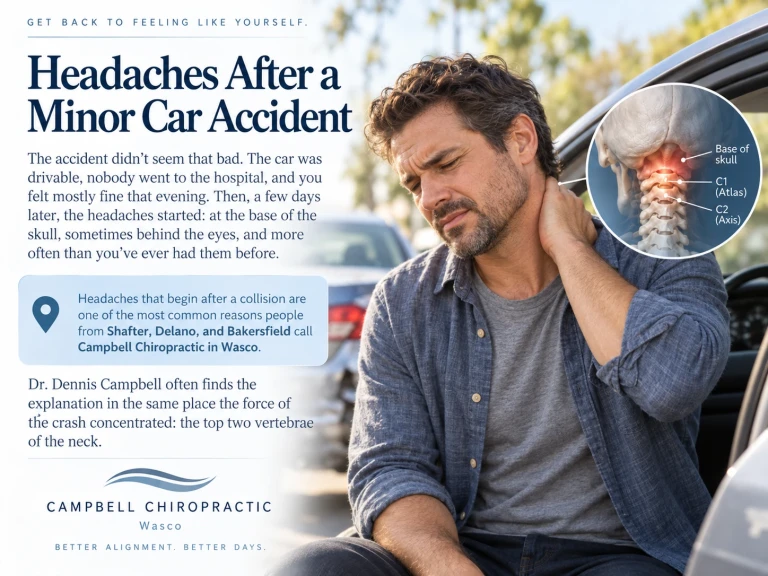
The accident didn't seem that bad. The car was drivable, nobody went to the hospital, and you felt mostly fine that evening. Then, a few days later, the headaches started: at the base of the skull, sometimes behind the eyes, and more often than you've ever had them before.
Headaches that begin after a collision are one of the most common reasons people from Shafter, Delano, and Bakersfield call Campbell Chiropractic in Wasco. Dr. Dennis Campbell often finds the explanation in the same place the force of the crash concentrated: the top two vertebrae of the neck.
Why Do Headaches Show Up Days After the Accident?
In a collision, especially from behind, the body is pushed forward before the head can follow. The head snaps back and then forward in a fraction of a second, long before your muscles have time to brace. That's whiplash, and it can happen at speeds low enough to leave barely a mark on the bumper.
Symptoms are often delayed because adrenaline masks pain in the first hours. Inflammation in strained muscles and ligaments then builds over the next day or two, and stiffness sets in as the body guards the injured area. By the time the headaches arrive, many people no longer connect them to the accident.
Why Does the Upper Neck Take So Much of the Force?

Your head weighs roughly as much as a bowling ball, and it's balanced on the atlas, a ring of bone held in place mostly by ligaments rather than a thick joint. During whiplash, the head's momentum pulls hardest on those upper ligaments.
If they're stretched, the atlas can settle into a slightly misaligned position. The muscles around it then work constantly to stabilize the head. Nerves from the top of the neck share a relay station in the brainstem with the nerves of the head and face, so irritation there is often felt as a headache at the base of the skull, the temple, or behind an eye.
Why Does Treating the Headache Alone Often Fall Short?
Pain relievers and muscle relaxers can take the edge off, and they have their place in the first days after an injury. But if the upper neck stays misaligned, the source of the headache remains. That's why some people are still dealing with post-accident headaches months later, long after the bruises and the insurance claim are gone.
When Is a Headache After an Accident an Emergency?

Go to the emergency room right away if a headache after an accident:
- Keeps getting worse, or comes with repeated vomiting
- Comes with confusion, unusual drowsiness, or trouble waking up
- Comes with weakness, numbness, slurred speech, or vision changes
- Follows a hit to the head, especially in older adults or anyone on blood thinners
Bleeding around the brain can develop slowly and sometimes shows up days after the injury. Anyone with these signs needs medical imaging first. Dr. Campbell takes that screening seriously and refers when it's needed.
How Is a Post-Accident Headache Evaluated at an Upper Cervical Office?
Dr. Campbell is one of only a few hundred practitioners worldwide who focus exclusively on Blair upper cervical work. He uses precise imaging analysis to determine the exact direction and degree of an upper cervical misalignment. The correction is very gentle, with no twisting, popping, or cracking. That matters when a neck has just been through a collision.
Patients from Wasco, McFarland, and across the San Joaquin Valley are often surprised that care after an accident doesn't require forceful adjustments. The goal is to restore the upper neck's position, then check at each visit whether it's holding while the injured tissues heal.

Frequently Asked Questions
1. How long after a car accident can headaches start?
Headaches often begin within hours to a few days after a collision. Many people feel mostly fine at first, because adrenaline and gradual swelling delay the pain.
2. Can a minor accident cause whiplash headaches?
Yes. Whiplash can occur at low speeds, even when there's little visible damage to the car, because the head moves faster than the body can brace for.
3. What does a whiplash headache feel like?
It often starts at the base of the skull and can spread to the temple, forehead, or behind the eye. It's typically worse with certain neck movements or long periods of looking down.
4. Should I see a doctor after a car accident even if I feel fine?
Yes. Getting checked soon after an accident documents any injury and catches problems early. Seek emergency care immediately for worsening headache, vomiting, confusion, or neurological symptoms.
5. Can upper cervical chiropractic help headaches after a car accident?
When the headache comes from an upper neck misalignment caused by the accident, correcting that alignment addresses the source. Dr. Campbell uses imaging to determine whether that's the case.
Don't Wait for It to Settle on Its Own
Headaches that started with a collision rarely resolve by being ignored. Call Campbell Chiropractic at (661) 758-5131 or visit us at 620 E St, Wasco, CA 93280 to have your upper neck evaluated.


Leave a comment