

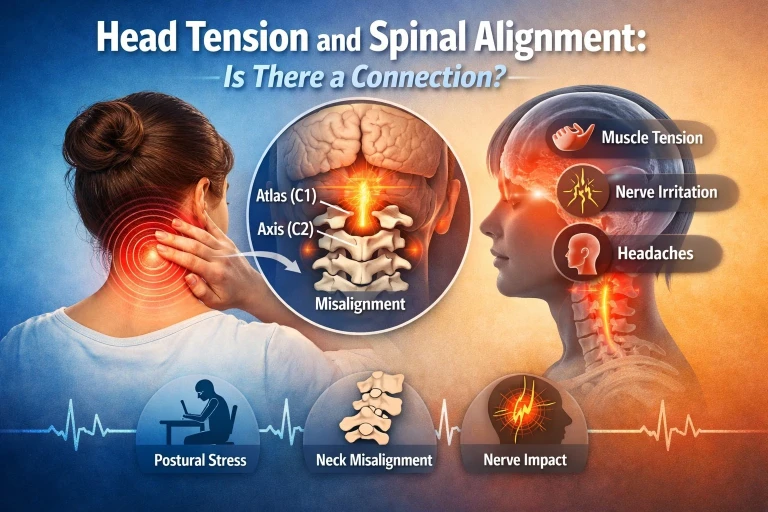
Head tension is one of the most common complaints in musculoskeletal practice. Patients often describe it as pressure at the base of the skull, tightness wrapping around the temples, or a band-like sensation across the forehead.
While many assume it is simply stress-related, there is a deeper biomechanical relationship that deserves attention: the connection between head tension and spinal alignment, particularly in the upper cervical spine.
For those exploring care with an upper cervical chiropractor, understanding this relationship can clarify why precise spinal assessment may influence symptoms that seem unrelated to the neck.
Understanding Head Tension
Head tension is often associated with what is commonly labeled as a tension-type headache. Unlike migraines, tension-related discomfort typically presents as:
- Dull, aching pressure
- Tightness around the scalp or temples
- Sensitivity at the base of the skull
- Neck stiffness
While emotional stress can play a role, mechanical factors frequently contribute to ongoing symptoms. The muscles at the base of the skull, including the suboccipital group, are small but neurologically dense. They communicate constantly with the brain regarding head position and balance.
When these muscles are chronically overworked, irritation and sustained contraction can occur. The question then becomes: what causes them to overwork in the first place?
The Upper Cervical Spine’s Role
The upper cervical spine consists primarily of the atlas (C1) and axis (C2). These two vertebrae support the skull and allow for a significant percentage of head rotation and flexion-extension. They also sit in close proximity to the brainstem.
Because the head weighs approximately 10–12 pounds in neutral posture, even small alignment deviations can alter how forces are distributed through the neck. If the atlas or axis shifts out of optimal alignment, compensatory muscle tension may develop to stabilize the head.
This compensation can lead to:
- Persistent suboccipital tightness
- Reduced cervical range of motion
- Increased pressure sensation around the head
- Fatigue in neck and shoulder muscles

Over time, this pattern may perpetuate chronic head tension.
Posture, Modern Habits, and Mechanical Stress
Forward head posture has become increasingly common. Prolonged computer use, smartphone viewing, and sedentary work environments place the head in a forward position for extended periods.
For every inch the head shifts forward, the effective weight on the cervical spine increases significantly. This increased load demands constant muscle engagement. The upper cervical region becomes a focal point for this strain.
An upper cervical chiropractor evaluates not just posture but the structural alignment of the atlas and axis. Even subtle misalignments can disrupt balance, leading to muscular guarding and tension patterns.
Neurological Considerations
The upper cervical spine is uniquely positioned near the brainstem, which regulates vital autonomic functions. While head tension is primarily mechanical in many cases, neurological irritation can amplify muscular responses.
When joint mechanics are altered in the upper neck, mechanoreceptors in the surrounding tissues may send altered signals to the central nervous system. This can contribute to:
- Heightened muscle tone
- Protective guarding
- Altered pain perception
Restoring optimal joint alignment may help normalize these neurological inputs, reducing the stimulus for persistent muscle contraction.
How an Upper Cervical Chiropractor Evaluates Head Tension
Upper cervical chiropractic care differs from generalized spinal manipulation. The focus is highly specific and typically involves:

- Detailed postural assessment
- Precise imaging or analysis of C1 and C2 alignment
- Gentle, targeted corrections rather than forceful adjustments
- Follow-up evaluation to ensure stability
The goal is not repeated forceful manipulation, but restoration and maintenance of proper alignment so the body can stabilize itself.
When alignment improves, the muscles no longer need to compensate excessively. Reduced muscular demand can translate into decreased head tension frequency and intensity.
Frequently Asked Questions
1. Can spinal misalignment cause head tension?
Yes. Misalignment in the upper cervical spine can lead to muscle compensation and sustained contraction, contributing to tension-type head discomfort.
2. Why does tension often start at the base of the skull?
The suboccipital muscles attach directly beneath the skull and are highly sensitive to positional changes. When overactive, they create pressure in that region.
3. s upper cervical chiropractic safe?
Upper cervical techniques are typically low-force and precise. They focus on gentle corrections rather than high-velocity movements.
4. How long does it take to see improvement?
Response varies. Some individuals report changes quickly, while others require a stabilization period depending on chronicity and structural adaptation.
5. Does posture correction alone fix head tension?
Postural awareness helps, but if underlying alignment of the atlas and axis is compromised, muscular strain may persist despite ergonomic improvements.
The Compensation Pattern
The body constantly adapts to maintain balance. If the upper cervical spine shifts, the rest of the spine often compensates. Shoulders may elevate asymmetrically. Thoracic posture may change. Jaw tension may increase.
This cascading compensation can intensify head pressure sensations.
Correcting the primary imbalance rather than chasing symptoms may reduce the need for ongoing muscular compensation.

Differentiating Head Tension from Other Conditions
Not all head discomfort originates from the cervical spine. Migraines, vascular conditions, and systemic causes must be ruled out. However, when imaging and medical evaluation do not reveal pathology, mechanical origin becomes more likely.
Clues suggesting a spinal component include:
- Head tension worsened by sustained posture
- Relief after neck movement or stretching
- Accompanying neck stiffness
- History of minor trauma or whiplash
An upper cervical chiropractor evaluates these patterns within a structural framework.
Long-Term Considerations
Chronic head tension is rarely random. It often reflects ongoing stress on the musculoskeletal and neurological systems.
Addressing:
- Spinal alignment
- Ergonomic habits
- Muscle endurance
- Sleep posture
Upper cervical care focuses specifically on structural precision at the top of the spine. When the foundation beneath the skull is balanced, muscular workload may decrease significantly.
Conclusion
There is a clear biomechanical and neurological relationship between head tension and spinal alignment. The upper cervical spine plays a critical role in supporting the head and maintaining neurological balance.
When alignment is compromised, compensatory muscle activity can lead to persistent tightness and pressure sensations. By evaluating and correcting structural imbalances at C1 and C2, an upper cervical chiropractor addresses a potential root contributor rather than masking symptoms.
For individuals experiencing chronic head tension without clear pathology, structural assessment of the upper cervical spine may provide meaningful insight into the underlying cause.


Leave a comment